Tuesday, September 10, 2013

The Broomes Theorem: Growth and Development

As mentioned in a previous post, I would be sharing bits and pieces of the upcoming publication of the Fascia Therapy concept and its application with the realm of neurodevelopmental disorders (NDD).  Although NDD is a vastly complex definition with a diverse spectrum of manifestations, the Broomes Theorem (formerly :Fascia Therapy Theorem) attempts to implant the rehabilitative strategy within a systematic framework that will ultimately support and facilitate effective understanding, implementation, and (eventually) outcomes.

Therefore, I have decided to "dissect" the fundamental developmental theory, that can therefore be imported into a variety of different pathological or non-pathological circumstances, to share here in this post.  It serves to provide a foundation for further strategic formulation and planning, as well as to convert an otherwise complex systemic and mechanical challenge into a more manageable task. It essentially outlines the theory of the fundamental interdependance of compressional and tensional forces within the growth and development context.  Moreover, it demonstrates the sequential "evolution" from primitive compressional stresses, to secondary tensional involvement, and finally to integrate into the biological organism that manifest biotensegral properties.


The main objective of this "sneek-peek" is to determine the more fundamental and prominent stages of development within the first year of life.  The first 12 months of life are critical to the future potential of the human organism, therefore an enhanced perspective on the evolution from compressional forces to the addition of tensional stresses to form a conglomerate biotensegral organism will ultimately help to design effective strategy.

More to come!

Sunday, September 1, 2013

Function Defined

Function is a term that is intrinsically well understood and has implications beyond the biomechanical spectrum.  It is this precise "comfort level" with this term which perpetuates occasional oversight and oversimplification of its true definition.

The general "definition" of function can be summarized as an outcome that is derived from one or more interdependant sources. For example, force (F) is a function of mass (m) and acceleration (a).  In the biomechanical sense, "function" is essentially the same...however this concept is often lost. 

Therefore, a focused "re-learning" of the component parts of function will ultimately provide an expanded perspective into how this understanding can translate into more efficient and productive treatment strategies.  This can be done via a very simple formula:

Function = Force Activation Source + Force Transferring Source + Force Limiting Agent

The Force Activation Source refers specifically to the muscles themselves.  Although forces are also generated from  interactions with the ground, exposure to environmental stimulii, and autonomic activity, the musculoskeletal system is the primary catalyst with respect to function in the "locomotive" sense. 

Force Transferring Source is likely the most underappreciated component of this equation.  The common error is to consider the source of force only...however how the generated force is transmitted and transfered effectively determines the overall outcome.  There are 3 primary considerations within the transferring context: 

1) Tendons  2) Myofascia / Periosteum  3) Adjacent Tissues

During muscle activation, tensional force is subsequently translated into the tendon which is intimately related to the periosteum at the insertion point (in fact, tendon and periosteum are continuous with each other and are actually a singular tissue which has been characterized as 2 different tissues out of convenience).  This myotendinal / periosteal action is governed by the myofascial "architecture" that provides a paradoxical connection and "disconnection" of the working / non-working muscles...which essentially perpetuates metabolically efficient operation.  The considerations of adjacent tissues is a relevant consideration because they are directly involved in either the loss or gain in energy.  Adjacent tissues that manifest some dysfunction (fibrosis, edema, etc) can reduce the overall transmission of force...and perhaps more relevant, contribute to chronic conditions due to inefficient muscle activation and force transmission.

Limiting Agents are the vast array of ligaments and joint capsules that surround and contribute to biomechanical operation.  These specialized connective tissues are designed to absorb forces and therefore stabilize and protect excessive impacts and ranges of motions. 

In summary, the Function Equation should be well integrated and implemented when any functional assessment and evaluation is in effect.

FeQ = F(a) + F(t) + L

In more practical terms, the careful evaluation of muscular performance, fascial health, tendonal integrity, adjacent structures, and joint integrity of at least 4-5 adjacent joints should be fundamental minimal "starting point" for any sage rehabilitative strategy.

Cheers!


Wednesday, August 7, 2013

The BroomesTheorem


This post serves more as a "heads-up" as opposed to anything otherwise informative.  To date, I have managed to accumulate a solid 21 years of professional experience in the field of health sciences...ranging from high performance fitness training, teaching human anatomy in University science labs, and more recently to the rehabilitative challenges of neurodevelopmental disorders.  Although the years may span a decent period of time, it is actually the diverse population of people and experiences that are perhaps the most valuable.  I have been fortunate enough to work with some of the most physically impressive specimens as well as some of the most fragile individuals imagineable...and everything in between.

It is with this plethora of exposure, combined with many interactions with intelligent collegues, and some all-important healthy criticism, that has lead to the Fascia Therapy concept I am currently launching in Chile and abroad.  This new and refreshing endeavour has lead to the opportunity to present this experience and philosophy in writing in the form of a formal publication...hopefully to be released sometime in the very near future.  This conglomerate of experiences, theories, formulations, and philosophies has come together to form what I have termed: The Fascia Therapy Theorem for Neurodevelopmental Disorders.  

Although the official text has yet to be completed...and is still very much in "draft" form, I wanted to share the current introduction here for those interested to read.  I am somewhat unfamiliar with publication "protocol", however I am hoping to be able to share more "bits and pieces" as time goes along.  It is only a very small portion if the entire text, but it should present a decent image and "texture" for the entire body of work.

Cheers!


New Frameworks and Solutions in Rehabilitation for Neurodevelopmental Disorders
Gavin Broomes  B.Sc.


 Introduction:

                The objective of this chapter is to present a global perspective on what can be considered a very elusive and daunting topic.  Neurodevelopmental disorders are very diverse and present equally diverse manifestations and challenges.  However, despite this reality, there are some very tangible similarities that essentially allow the medical professional / practitioner to impose a significant amount of productive and positive benefit which will ultimately result in more manageable situations, more efficient treatment strategies, and significantly better treatment outcomes. 

In the 20+ years of formal education, clinical, and hands-on experience leading up to this current philosophy, I have been fortunate enough to have been exposed to a very wide spectrum of human performance…from the most highly trained athlete to the most fragile child with neurodevelopmental disorder.  It is my firm belief and conviction that this exposure has provided some valuable insight and perspective into the exponentially complex human organism.  In essence, a very explicit demonstration of not what separates these two polarities (which is relatively obvious and certainly intuitive)…rather what is the common thread between them.  This is a seemingly paradoxical suggestion…how can two polarities (extremes) share anything in common?  The answer to this is that both are not exclusive entities, but are simply very different manifestations of the singular human condition. To be more precise, they both share the same embryological material and subsequently contain the same “architectural building blocks”…which effectively serve as the key to elicit the most powerful systemic and mechanical change.   

This fundamental understanding was the genesis for the development of the new frameworks and solutions presented in this chapter.  It was important for me to formulate this relatively complex philosophy to reflect a certain “neutrality” with respect to any specific belief, conviction, or position a professional may have.  Any such bias would inevitably result in the breaking of the “law of contradiction” which specifies that any allegiance towards a specific “technique” or approach would essentially imply that any other course of action or belief would be “wrong”…therefore a philosophy that is based in fundamental neutrality can be applied across the entire spectrum of personal and professional ideals and convictions. 


1.       Organic Versus Mechanistic Perspectives:

The Organic vs. Mechanistic comparison is typically associated with the analysis of business models and issues surrounding hierarchical structures of large corporations, however when this general philosophy is imported into the biological analysis it demonstrates equal ability to elicit enhanced clarity and perspective on an otherwise complex task.

Mechanistic Organization
This type of organization is characterized by hierarchical and “bureaucratic” focus.  Within the biological context, this is the overall equivalent to the overwhelming focus and attention solely on the neurological considerations…or in essence, a “top-down” mentality where the central nervous system (brain) is locus of control for everything.  This analysis is in-line with the precise definition of a mechanistic organization:  highly centralized authority, formalized “procedures and practice”, specialized functions. 

The mechanistic perspective in the neurodevelopmental context is almost a necessity due to the fact that it is easier and simpler to manage.  Additionally, it provides significant quantitative metrics through which practitioners can measure progress, deterioration, and even assign diagnoses.  Although relatively easier to manage, it is very sensitive to rapid change.  The essential “chain of command” is quite strong and therefore requires that all decision-making come directly from the top.  In that sense, the brain is considered as the overriding system that ultimately controls, moderates, and directly influences all physiological functions…from the systemic to the mechanical.  Further, this organizational structure is characterized by “communication” and information flowing solely from the upper levels…even more so, any communication that goes to (or comes from) the bottom is vertical, meaning that there is very little lateral communication within the lower levels.


Organic Organization
In contrast the mechanistic organization, organic organization is characterized by what is defined as “flatness”, which essentially means that communication and interaction is primarily horizontal.  Ironically, there is also a certain low level of specialization which indicates that elements (tissues, in the biological context) adopt many different roles depending on the specific environment and stimulus.  An example of this would be the paradoxical role of connective tissue as both “connecting” and “disconnecting” contributors…in addition to its role in force transmission, injury repair, and systemic homeostasis.  Additionally, there is a characteristic “decentralization” in the decision-making process…meaning that some actions / reactions are directly and indirectly managed by the lower levels (or the more primitive levels, in the biological context). 

The organic organization reflects a contrasting “bottom-up” performance and therefore is extremely adaptable and flexible to sudden, large, or rapid change.  The sharing of roles and responsibilities makes it “less fragile” and more robust. 


 Organic Organization and links to rehabilitation

This analogy is less of a dichotomy and more of a continuum.  To be precise, the human organism is exponentially more complex than a business model therefore it cannot be explained with a relatively simplistic analysis as this.  The “organic versus mechanistic” model ultimately serves as a philosophical framework that essentially encompasses a larger fundamental understanding which then results in a certain clarity of thought. 

The complexities of the human organism are far too numerous to describe…and given that we have yet to uncover ALL of the wonders of the human body, the absolute complexity remains a mystery.  It is this fundamental reality that underlines the necessity for an expanded perspective when it comes to the added complexities of neurodevelopmental disorder. 

Assuming a hierarchical / mechanistic approach alone lends to the unrealistic assumption that we have ultimate control over the human organism and the associated systemic and mechanical manifestations.  The infinite number of micro and macro processes that take place every second of every day are incalculable…and occur without conscious or voluntary input…and in some cases completely outside of the neurological context, relying solely on mechanical inputs to facilitate gene expression and tissue differentiation.   In essence, the majority of human processes exist on this “primitive and autonomic” plane.  The so-called “voluntary or mechanistic” manifestations are effectively REFLECTIONS of a functioning organic system of auto-regulation, self-organization, and self-healing. Therefore, any and all interventions that develop, support, and nourish the primitive systemic oscillations (respiration, circulation, digestion, lymph) ultimately provide the most beneficial and “metabolic cost-effective” strategy for improvement of overall health and homeostasis.


Monday, July 15, 2013

Rehabilitative Strategies in Cerebral Palsy: Understanding Hierarchy


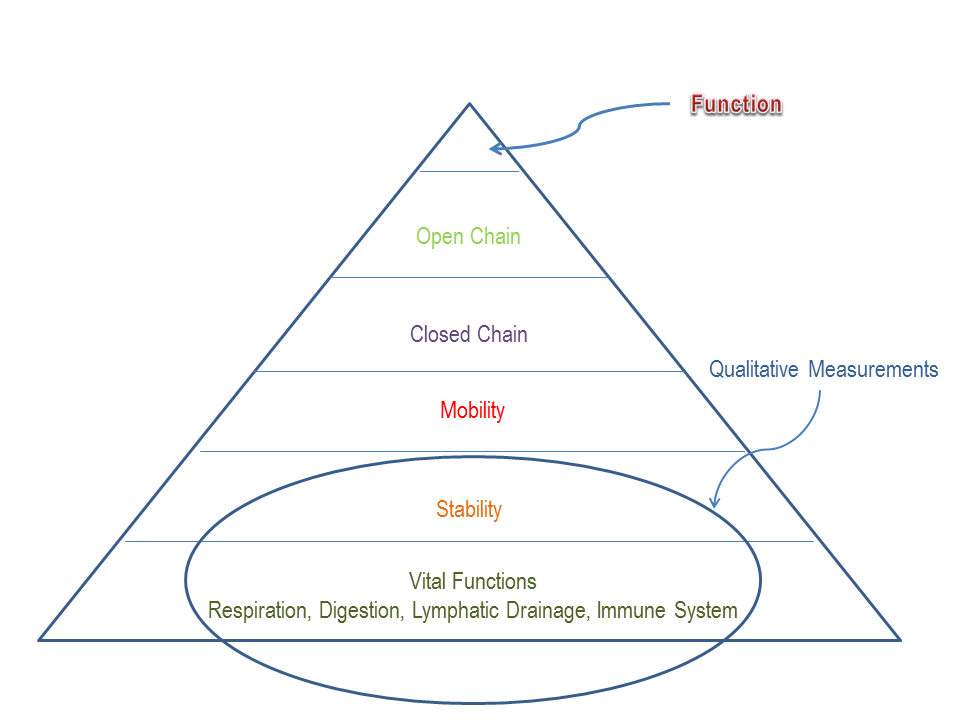
The title is quite a mouthful...but it is a very precise description of an otherwise overlooked reality.  Hierarchical structures not only provide a sense of structure and organization (where things exist in relation to others) but they give a rather profound demonstration of perspective...or to be more precise, a sense of direction and flow.

As the colourful image explicitly demonstrates, each component has its own individual identity and purpose...however, it exists within a larger framework.  Although each has its own intrinsic operation and purpose, it essentially serves the larger whole.  This is likely intuitive to most, however this intuition seems to be put aside as soon as a therapeutic or rehabilitative context is in play.

Although exponentially more complex, the developmental process can be thought of as a very sophisticated and comprehensive hierarchy.


The most basic and fundamental elements of any human organism (for the simple sake of survivial) are the vital functions.  Without coherent establishment of the systems that sustain life, any other consideration(s) are irrelevant.  Further, proper functioning (or interaction) of the human organism within the environment REQUIRES that these vital functions be well-established in order to generate productive results.

The primary dilemma with this fundamental perspective is that these critical components are somewhat difficult to measure in the quantitative sense...in essense, they are QUALITATIVELY measured.  The conflict between what "can" and "can't" be measured is quite prolific in the rehabilitative context...meaning that thise elements that have no quantitative measure are very often dismissed or disregarded.  However, the reality still exists:  without the development, maintenance, and nourishment of systemic homeostasis there is no life...even if the operating level / coherence is poor, there is still an overwhelming need to develop these fundamental elements to their best potential. 


Mobility and closed-chain can easily be confused and inter-changed within the neurodevelopmental disorder (NDD) context.  In more practical terms, it referes to the selective independant mobility (freedom) that exists within each of the diverse segments of the body.  This includes ALL of the traditional "joint-like" articulations as well as the equally important fascia larticulations within the body.  Therefore, the term "mobility" is used, not to define movement as such, rather to describe some level of intrinsic elasticity and adjustment to positional changes.  If we extend this description further, we arrive at the term "closed-chain"...which can understandibly refer to a vast number of specific movements and dynamic activity.  But, once again, when we consider the NDD context, a closed chain activity refers primarily to postural characterisitics such as independant sitting, balance, and counterbalance.  These considerations MUST be addressed and developed before any consideration or focused strategy regarding more dynamic (open-chain) function. 


It isn't until we reach the "peak" of this schematic that we entertain the notion of what would be considered "traditional movement-based strategy".  If we consider this generic illustration, it clearly suggests that any and all movement-based strategy must be "earned" via the establishment of coherence between the elements that preceed it.

In summary, the general "landscape" of the rehabilitation strategy should reflect the natural process of development and growth.  This is indeed an obvious over-simplification of the reality...however working frameworks only require a solid philosophical basis from which to operate.  Effectively, a simple framework can be a valuable tools when assigning treatment strategy and protocols...and most certainly yields some enhanced clarity and perspective.

Cheers!

Monday, July 8, 2013

DIS-stress VS EU-stress: Fundamentals in Neurodevelopmental Disorders

I have recently come to realize that despite the best attempts at providing detail and in-depth analysis, it is often the more simplified analogy or "generalized" understanding that has the most resonance.  Therefore I think it is important to present complex systems (at least at the beginning) in more simplified terms...or in this specific case, outline basic frameworks and fundamentals when it comes to neurodevelopmental disorders.

In the current conventional understanding, STRESS is widely considered as a negative term...however, its true definition is neutral.  Stress can either promote improvement and well-being or contribute to various forms of deterioration.  Within the Fascia Therapy context, eustress is a positive response to any specific stressor.  This can be demonstrated in the biomechanical sense, for example, via the process of mechanotransduction...which is the healthy adaptation and response by a cell to an imposed mechanical stimulus.  In the systemic sense, it is quite easily illustrated in the form of vaccinations...which are essentially carefully moderated doses of select viruses (systemic stressors) which therefore solicit a physiological adaptation and ultimately a stronger immune system.

Until this point, all of this is likely to seem somewhat "un-amazing" and ultimately quite intuitive...but when we consider the challenges of neurodevelopmental delay this simple intuitive understanding needs to evolve into another level of understanding.  Within each of us, there exists an essential repetoire of available systemic and mechanical resources that essentially serve as a "converter"...converting imposed stresses into positive responses or potentially negative ones.  The fundamental reality within the neurodevelopmental disorder context is the following:

There exists an underlying neurological, systemic, and mechanical deficit that essentially "shrinks" the repetoire of available resources.

In more simple terms:  the "converter", or available range of potential eustress response is much more limited. 

  When the systemic and mechanical "converter" is reduced, each imposed stimulus can potentially contribute to deficient or incomplete adaptation, which can result in exaggerated compensatory responses, as well as produce high levels of irritability which ultimately generate a very sensitive and volatile environment.  Therefore, we are confronted with an alarming dilemma:  if imposed stimulus (chemical, emotional, environmental, or mechanical) can generate volatility and DIS-stress response, how do we go about the task of rehabilitation?  The intuitive answer, and the one which is BOTH correct and the overwhelming default, is to attempt to deliver these stresses in th most careful and deliberate fashion.  The specific "doses" of chemical, mechanical, environemental stressed are gauged by what are essentially predetermined standards of application and procedure.  Although I do not disagree with this approach, the effort to enhance and BROADEN ones perspective on the subject only serves to contribute to more effective and diverse strategic options and ultimately better rehabilitative outcomes.


One of the fundamental pillars of the Fascia Therapy concept and philosophy is the incremental and focused strategy of potentiating interstitial fluid flow and the promotion of healthy connective tissue remodelling.  Both of these "targets" are independant of the specific strategy or "technique" because they effectively exists on a more comprehensive and "primitive" level.  In essense, they are the essential elements to the development and maintenance of enhanced systemic and mechanical resources...therefore they contribute to an amplification and broadening of the stress "converter".
This allows for a more diverse range of stimuli being converted into a stress that is efficiently absorbed and distributed...and consequently elicits a positive adaptive response.

In summary, the precise "how" this is done falls into a secondary category...it does not matter as to what specific "technique" is used to stimulate these two fundamental pillars, it only matters that it is done efficiently and with additional focus and attention.

Cheers!

Sunday, June 23, 2013

Good Therapy ~ Bad Therapy

 
This is a "note" that I had  originally generated for the OGL Facebook page in December 2012...but given the recent evolution of the Fascia Therapy concept and the message of philosophical inclusivity and open perspectives, I thought it would be a good choice to give this brief rant a post of its own! I hope it resonates and reaches some intrinsic level of common sense.  Cheers! 


Good Therapy ~ Bad Therapy  (Originally posted December 2012) 
  

It has been a couple of months since I have posted a note here, but there are always many things (big and small) running through my head following an extensive session of evaluations and assessments.  I have recently finished a week-long trip to Colombia which not only proved to be successful and encouraging, but presented a unique opportunity to engage in direct discussion and debate with a varied and diverse professional audience.  This was both an informative and enlightening experience.  Although my collegue Richard Paletta was the main speaker (my trip was in Colombia which presented some language barriers), I was able to listen and absorb quite alot of information during the formal presentations and also was able to engage in some informal chats (in broken spanish, of course) afterwards.  The resultant realization was that there are more similarities between the diverse therapies than there are differences.

I have found that the fundamental challenge (or sometimes conflict) comes from relatively mundane sources:

- Pride
- Ego
- Stubborness

These relatively universal traits are present in everyone and therefore have a direct impact on therapeutic strategy and philosophy.  These are coupled with what appears to be an intrinsic resistance to examine, investigate, or rationalize different perspectives.  Even more rare is the idea of questioning one's own philosophy...which I have found to be the most productive method of professional growth.  The discussion therefore leads back to the title of this note:  Which therapies are "good" and which therapies are "bad".  As much as this is a common question (and also an intuitive question), it is a fundamnetally poor question to ask.  If this was a question that could be answered, there would be no real debate on what to do...or when to do it.  During my trip to Colombia, my collegue Richard conveyed a very enlightening and equally accurate statement that essentially encompasses the essential understanding:

There are no bad therapies, just bad therapeutic decisions.

With this fundamental concept in mind, the path towards effective strategies becomes much clearer...and therefore the results are more effective and more efficient.  I think that adopting this perspective ultimately enhances everyone's ability to effect positive change...both within the patient and within the professional themselves.

Cheers!


Wednesday, June 12, 2013

OGL turns 2!

It has been a very interesting and (hopefully) educational 2 years since the launch of my blog...and I must say the experience has been better than expected.  Not only has it facilitated great contact and communication from all corners of the world, but it has been a significant contributor to my own internal and instrinsic understanding of the diversity and complexity of rehabilitation.

Year 1 saw a healthy 8,000 pageviews which was more than satisfactory...year 2 has been an absolute surprise with an additional 37,000 pageviews to bring the current total to just over 45,000 views! 

Many thanks to all of those who have stopped in to read and especially to leave their comments and feedback. It has all been assimilated and will certainly contribute to a more informed and productive blog (and a few rants, as well).  

Stick around for year 3...and thanks for reading! 

Monday, June 10, 2013

Mecanotransducción: Respuesta a la Terapia Manual


Debo disculparme mis pocos lectores por el largo atraso entre los post. Mi regla no oficial es producir unos 3 ó 4 posts por mes... Sin embargo, parece que los recién nacidos ¡no siguen esa regla! Ahora que he tenido algunos meses para ajustar, recargar y reenfocarme, comenzaré mi “re-ingreso” a la blogósfera con un post breve de vuelta a los básicos.


Recientemente he estado navegando en las publicaciones web de Inger Lab (muy buen sitio para los nerds de la fascia como yo) y me vino la realización de que una gran cantidad de información está frente a nuestras narices... Tan sólo requiere algo de esfuerzo que “cavemos” por ella. ¿A qué me refiero? La mayoría de la gente tiene la comprensión obvia e instintiva de que “si recibo terapia manual, me sentiré mejor”. Para la mayoría, esta comprensión básica es suficiente... Por ejemplo, no necesito saber COMO funciona una pantalla tactil en el computador. Sólo necesito saber que efectivamente funciona.

Pero para una mente más investigadora (tanto quien da cuidados como quien los busca), sigue estando la pregunta de ¿cómo la manipulación activa del tejido se traduce en una respuesta inmediata o a largo plazo? La respuesta es MECANOTRANSDUCCIÓN. Para ponerlo en términos simples, la mecanotransducción es el proceso por el cual las células (y por lo tanto el tejido mismo) siente estrés mecánico y convierte esas fuerzas en señales bioquímicas. A nivel celular, la señal es enviada al núcleo, afectando así al tejido en el nivel “macro” promoviendo el remodelamiento saludable.


Tal como ilustra tan elegantemente la imagen que se encuentra arriba, la célula misma es una construcción Tensegral que se conecta íntimamente con todo el organismo. Según el tipo de estrés (puro, compresión, tensión, étc.) la célula responderá de manera diferente. Por lo tanto, el TIPO de aplicación manual es de vital importancia tanto como el MODO en que se entregue (suave, agresivo, rápido, lento, étc.).

En cuanto al Paradigma Fascial, este es un entendimiento clave y un principio fundamental. El remodelado de tejido conectivo siempre es la meta final, sin embargo la clave es promover un remodelamiento SALUDABLE.

Mi mensaje final es simple: Incluso el elemento biológico más pequeño (la célula) puede sentir las diferencias en el estrés mecánico. Por lo tanto, el foco en las características de la aplicación de la técnica de terapia manual se vuelve más que importante... ¡Son críticas! La mecanotransducción nos muestra que hay un verdadero poder en la efectividad de la terapia manual... La verdadera “habilidad” viene con la comprensión de los mecanismos específicos de aplicación y respuesta.


Friday, June 7, 2013

Guía de Parálisis Cerebral: Desarrollo versus Cronológico

 Para los que me conocen bien, esta discusión será una familiar. Ha tomado bastante tiempo encontrar un modo efectivo para crear una mentalidad que no sólo resuene y aumente la comprensión, sino que también facilite un aprendizaje más efectivo y mejor comprensión en relación al viaje a recorrer con individuos con Parálisis Cerebral y sus familias inmediatas y extendidas. Utilizo el término “viaje” porque describe con más precisión el camino de larga vida que a veces es relativamente suave, a veces el viaje está lleno de obstáculos, y prácticamente siempre está evolucionando. Porque la “meta de llegada” nunca se puede predecir, es el viaje el que define el éxito... Por lo tanto, es lógico realizar todo intento por inculcar la perspectiva apropiada y un marco mental general que finalmente los sostendrá a lo largo del camino. Pese a que hay muchos “ángulos” y formas de tratar este tema, he encontrado que cuando hay una comprensión fundamental de la edad de desarrollo versus la edad cronológica, la mentalidad automáticamente se reinicia con un distinto “software mental”. 


Software Mental: De DOS 2.2 a Windows 7
Uso esta comparación familiar en un intento de ilustrar el relativo “salto” en perspectiva... En muchos modos, puede considerarse un mini cambio de paradigma. A lo largo de la sociedad humana, siempre ha habido una comprensión / expectativa subyacente en relación al comportamiento humano. Para ser más preciso, el comportamiento casi siempre es evaluado contra lo apropiado para su edad. El comportamiento se define ya sea como apropiado o inapropiado basado en la edad de esa persona. Sin entrar a hacer ningún reclamo sociológico complicado, eso no es diferente en la esfera de la Parálisis Cerebral. Más aún, está igualmente propagado en la mentalidad médica profesional como en la población general. De algún modo, esto es de esperarse... Todos vemos la vida relativamente desde el mismo prisma, por lo tanto, ¿por qué esto no se aplicaría a un individuo con PC? Aquí es donde surge la necesidad de “reinstalar” el software mental. 


La perspectiva apropiada no es algo que sea (o haya sido) difícil de encontrar... De hecho, ha estado bajo nuestras narices desde el principio. Alarmantemente, lo hemos visto y leído una y otra vez... Y nunca hemos nos hemos agarrado a él. Para ser más específico, sólo necesitamos referirnos a la definición misma para tener una mejor comprensión del viaje en la Parálisis Cerebral. La Parálisis Cerebral puede considerarse como una condición que cae bajo el paraguas de retraso del desarrollo. Este es un paraguas relativamente grande que incluye Síndrome de West, Síndrome Miller-Diekers, etc... Por lo tanto, esta perspectiva tiene implicancias más allá de la PC. Por definición, el retraso del desarrollo es una condición que se caracteriza por la ausencia o retraso de hitos del desarrollo naturales. También se define como la persistencia de reacciones primitivas y la ausencia de reacciones posturales. Para poner todo esto en términos claros: En el individuo con PC la edad del desarrollo no corresponde con la edad cronológica


Software Mental: Manual del Usuario
Ahora que esta perspectiva ha sido instalada, se requiere de una orientación básica y familiarización. La realidad de la gran mayoría de los casos es que los niños son “evaluados” basados en su edad cronológica y los logros del desarrollo correspondientes. Por ejemplo, un niño con PC de 2 años, típicamente se le dan estrategias y herramientas que están pensadas para lograr la meta funcional esencial de “caminar”. Sin embargo, la realidad bes que la edad del desarrollo de la pelvis, caderas, rodillas y pies son probablemente mucho más “jóvenes” y por lo tanto no están preparadas para ningún tipo de actividad de descarga de peso. Este es un ejemplo simple, por supuesto, pero habla de un problema muy complejo. Permítanme ilustrarlo con un ejemplo más preciso: Hasta los 10-14 meses, ocurren una gran cantidad de hitos del desarrollo... Desarrollo del control cefálico, mayor fuerza y estabilidad de la cintura escapular, estabilidad en la posición sedente, gateo, bipedestación, etc... Todas estas son etapas del desarrollo por las que todo ser humano debe pasar para poder lograr un desempeño funcional apropiado. En un niño saludable, todas estas (y más) son logradas antes de los 10-14 meses. Además, las reacciones primitivas (reflejo Moro, reflejo Landau, etc) han desaparecido alrededor de los 8-9 meses y han sido reemplazados por reacciones posturales tales como el apoyo lateral y contra equilibrio. En el individuo con PC, estas reacciones primitivas persisten por mucho más tiempo después de los 14 meses... pueden verse incluso en su adolescencia. 


Por lo tanto, el uso de la edad cronológica como un marco para la competencia /expectativa funcional o para evaluar otras preocupaciones importantes tales como la densidad ósea... está fundamentalmente fallado y fundamentalmente incorrecto. Los estándares realistas debiesen siempre referirse a la edad del desarollo más que a la edad cronológica. Si las reacciones primitivas (Moro, Landau) todavía están presentes, no importa cuál sea la edad cronológica, la edad del desarrollo de ese individuo será la de un niño entre los 0 y 14 meses de edad. 

No hay discusión sobre el conflicto interno que existe cuando se le pide a un padre considerar a su niño de 4, 5, 6 años como un infante... Sin embargo, la realidad arquitectónica y el desempeño del desarrollo es precisamente ese. Si hay una comprensión implífica de la definición del retraso neuroevolutivo... ¿Por qué esta comprensión no logra ir más allá de las palabras de una página? La edad de desarrollo del invidivuo define la intervención terapéutica apropiada que mejor se ajusta al progreso del niño. Pese a que este puede ser un gran salto en la perspectiva, la afortunada realidad es que este concepto hace que evaluar el progreso sea mucho más fácil. La desaparición gradual de reacciones primitivas y el desarrollo progresivo de reacciones posturales señalan el progreso a lo largo del proceso evolutivo. Lo que usualmente SIEMPRE se olvida es que el desempeño funcional es la reacción espontánea de una estructura madura! En un individuo saludable, no hay necesidad de “entrenar” los músculos o “entrenar” el cerebro para lograr madurez funcional... Es espontáneo. 


Apagarse: 
Pee a que puede tomar algo de tiempo realmente integrar esta perspectiva, espero que al menos estimule la aparición de algunos “mensajes de error” cuando se trata de decisiones importantes en relación a la estrategia de rehabilitación. Escribí algunos posts sobre Reacciones Primitivas y Posturales que sirvió para continuar este post básico sobre lo fundamental de la perspectiva apropiada que contrinuirán a la internalización de este importante concepto. Espero que les sea informativo y, más importante aún, de ayuda. 
Saludos!

Thursday, May 30, 2013

Who stole my cheddar?: Author's Op-Ed

I thought I would take a small detour from the typical (and hopefully) informative rants and go "off-script".  Every once in awhile, it is therapeutic to do so...if for nothing else to satisfy an internal need to simply vent.

I have often made the parallel between business and rehabilitation...mainly drawing links between "top down" management and strategy (which aren't too effective).  In recent days and months, it has become apparent that this parallel runs deeper than I had allowed myself to believe.  To be precise, the "business" of healthcare is characterized by much of the same intrinsic fears and insecurities that are rampant in the business world.  I always loved the saying "Who stole my cheddar?!"...in reference to someone ranting about how their business has been undermined somehow by someone.  One thing should be clear to all of those who consider themselves in the "business of providing healthcare" of any type:  there is enough cheddar for everyone.  

Success is built upon a genuine interest in providing effective and safe care...not in guarding one's position or status in the rehab universe, which is neither ours to give or ours to take.  I suppose I shouldn't be surprised at the realities of business...afterall it is central to our survival and existence.  However,  keeping to one's own "backyard" and focusing on personal and professional development will always prove to be a winner...and will ultimately steer away from unhealthy or otherwise unnecessary challenges.

Who stole your cheddar?...if someone was able to take it, I suppose it was never yours to begin with. 

Success is measured by how high you climb...not by how far you try to pull people down.

Educate.Motivate.Inspire.

;) 

Cinco Segundos con Leon Chaitow


No es común que yo mencione autores específicos o profesionales en mis posts, simplemente porque soy un firme creyente en la formulación de la filosofía propia de cada uno y un sistema de creencias central en oposición a adherirse ciegamente a la filosofía de otra persona o una filosofía única. Sin embargo, en la evolución de la filosofía central propia, debe entenderse que la exploración / examinación y absorción de otras posturas y enfoques es esencial para la formación de una postura propia válida, inteligente y responsable. 
La verdad es que obtener acceso a la “elite” en cualquier campo profesional es un desafío difícil. Suelen tener mucha demanda, estar extremadamente ocupados, o en ocasiones están demasiado absorbidos en sus propias actividades como para molestarse con preguntas de cualquier persona que no calce con su nivel de estatus. Pese a que está obviamente muy cansado y tiene alta demanda, puedo decir concluyentemente que el Sr. León Chaitow definitivamente no está ensimismado y es muy generoso para compartir su amplio conocimiento y experiencias con cualquier persona. Es probable que nuestro intercambio pase desapercibido para él, pero mi reciente breve intercambio con él para mí permanecerá como un refrescante gesto y servirá como ejemplo de conducta responsable e intelectual. 

Leon Chaitow ahora es un casi retirado naturista, osteópata y acupunturista con más de 40 años de experiencia clínica. También es el Editor a cargo del Journal of Bodywork and Movement Therapies. Es un autor prolífico que ha escrito más de 60 libros sobre salud natural y medicina alternativa. 
Es realmente un placer tener una retroalimentación de una figura tan conocida, por lo tanto he decidido postear los intercambios (muy breves) que ocurrieron durante los últimos días en relación a un par de sus posts y que llevaron a mi entrada anterior. Pese a que algunas de nuestras filosofías no se alinean completamente, es obvio que su aporte es valioso y ciertamente dará formará parte de futuras investigaciones y formulaciones. ¡Disfruten! 
Post de Chaitow: 
Más sobre la respiración: Sabían que las consecuencias fisiológicas de una hipocapnia (bajo CO2 debido a una respiración superficial con el pecho superior) incluyen: 

  • Reducción del flujo sanguíneo cerebral (4% por mmHg apróx.) 
  • Vasoconstricción cerebral 
  • Vasoconstricción coronaria 
  • Contracción de musculatura lisa de los intestinos 
  • Perfusión placental reducida 
  • Constricción de los bronquios 
  • Hipoxia cerebral y miocardial (déficit de O2) 
  • Vasoconstricción y Effecto Bohr 
  • Hipoglicemia cerebral 
  • Desequilibrio de magnesio y calcio en los músculos 
  • Isquemia (anemia localizada) 
  • Activación autonómica, descarga simpática 
  • Menor capacidad de neutralización... y más... 
En esta imagen, la disponibilidad de O2 en el cerebro está reducida en un 40% como resultado de casi un minuto de sobre respiración. Además, la glucosa, crítica para el funcionamiento cerebral, está notoriamente reducida como resultado de la vasoconstricción cerebral. Ver: Laffey, J. & Kavanagh, B. Hypocapnia, New England Journal of Medicine. 4 July 2002 
GAVIN BROOMES 
Saludos, Sr. Chaitow. Soy un kinesiólogo que trabaja principalmente con desórdenes del movimiento y la postura... La mayoría de los cuales son individuos y niños con Parálisis Cerebral. Para una abrumadora mayoría de los niños, el tórax está subdesarrollado y carece de la elasticidad apropiada y volumen toráxico. Además, hay una profunda disfunción de la mecánica respiratoria que se caracteriza comúnmente por patrones de respiración paradojales. Pese a que la respuesta a mi pregunta probablemente sea bastante intuitiva, ¿cuánto cree que esta distorsión estructural y disfunción contribuye a un aumento de la respuesta negativa del cerebro como se describe en su post sobre respiración? 
LEON CHAITOW: 
Yo diría que profundamente... Pero mientras que el trabajo estructural obviamente puede hacer algunos cambios en las restricciones, la barrera para el progreso viene de dificultades asociadas con la comunicación y enseñar mejores hábitos respiratorios. 
GAVIN BROOMES: De hecho, creo que mi filosofía principal sería que la mejora estructural puede servir como un catalizador efectivo en la respuesta final (por lo tanto éxito) para enseñar mejores hábitos respiratorios... Como una simbiosis. Brevemente, ¿le parecería que esto es correcto o su perspectiva es diferente? 
LEON CHAITOW: Así es precisamente como lo veo... Una estructura mejorada y la posibilidad de mejoras funcionales está marcadamente mejorada. 
Post de Chaitow #2 
En entradas recientes, he intentado destacar algunos de los efectos generales de los desórdenes del patrón respiratorio (BPD por sus siglas en inglés). En este post, mi foco estará en enfatizar la relación directa entre BPD y el dolor y disfunción de la pelvis. 

EXTRACTO DEL CAPÍTULO 9: "Respiración y Dolor Pélvico Crónico: Conecciones y Rehabilitación", de Chronic Pelvic Pain & Dysfunction: Practical Physical Medicine. Chaitow L Jones R (Elsevier 2012). Para más información sobre este libro y sus capítulos, visiten: http://www.leonchaitow.com/chronicpelvicpain.htm 
<<<< Con continuidad estructural y funcional entre el diafragma, la pelvis, los músculos del piso pélvico (PFM), quadratus lumborum, el psoas, y los órganos del espacio retroperitoneal, se sugiere que las estructuras del espacio abdominal requieren evaluación y, si es apropiado, tratamiento en relación a la disfunción pélvica. VER LA ILUSTRACIÓN DEBAJO QUE MUESTRA ALGUNAS DE LAS CONEXIONES ESTRUCTURALES AL DIAFRAGMA, INCLUYENDO EL PSOAS Y QL QUE SE FUSIONAN CON EL. 
Grewar & McLean (2008) indica que las disfunciones respiratorias comúnmente se ven en pacientes con dolor en la parte baja de la espalda, disfunción del suelo pélvico y una postura pobre. Existe evidencia adicional que conecta desórdenes diafragmáticos y patrones respiratorios, con varias formas de disfunción de la cintura pélvica (incluyendo el dolor sacro-ilíaco) (O’Sullivan & Beales 2007) así como también con CPP y síntomas asociados, tales como incontinencia de estrés (Hodges et al. 2007). De manera similar, Carriere (2006) notó que una función interrumpida ya sea del diafragma o del PFM pueden alterar los mecanismos normales de regulación de la presión intra-abdominal (IAP). 
La presencia de patrones disfuncionales respiratorios que influencian la función pélvica (McLaughlin 2009) y disfunción pélvica que influencia los patrones respiratorios (Hodges et al. 2007) por lo tanto, sugiere que la rehabilitación del tórax, cintura pélvica y suelo pélvico se verá mejorada con patrones respiratorios fisiológicos más normales. Esto puede lograrse mediante el ejercicio, re-entrenamiento respiratorio, terapia manual y otros medios (Chaitow 2007, O’Sullivan & Beales 2007, McLaughlin 2009).>>>> 


GAVIN BROOMES
Muy interesante. Parece que este es un ciclo degenerativo que simplemente se perpetúa a sí mismo (disfunción respiratoria influencia la función pélvica, la función pélvica influencia la disfunción respiratoria). Como un punto de estrategia de tratamiento, hay muchas escuelas de pensamiento que dicen "dónde entras a este ciclo" para resolver el problema. Pese a que tratar ambos (si es posible) es un enfoque intuitivo, yo me inclino más hacia la filosofía "la estructura es función"... es decir, que la debilidad arquitectónica de la pelvis (desde una perspectiva biotensegral) es más el catalizador de la disfunción respiratoria. Pese a que cada caso es altamente variable, ¿cuál es su opinión sobre esta filosofía en general? Usted afirma que el protocolo de rehabilitación puede realzarse mejorando los patrones respiratorios fisiológicos... Con lo cual concuerdo, sin embargo, tengo curiosidad por su visión sobre el tema de mi postura sobre que la estructura es función y dónde "entrar al ciclo degenerativo". ¡Saludos! 
LEON CHAITOW
Estoy de acuerdo con su comentario intuitivo sobre trabajar en ambas áreas simultáneamente, Gavin. En mi propio trabajo de rehabilitación, los ejercicios son dados junto con material educativo y desde la base de movilización estructural, tonificación, rebalance, etc. No estoy muy seguro de que "la estructura gobierne la función", porque he visto funciones mejoradas que restauran la integridad estructural. Sin embargo, también he visto restricciones estructurales que impiden el progreso funcional hasta que se modifican... 
Bueno, esos fueron mis 5 segundos con Leon Chaitow. Espero que hayan más oportunidades de interactuar con él en el futuro. 
Gavin.